The Two Pillars of the Dry Battery Market
Alkaline and carbon-zinc batteries together account for the vast majority of global primary battery sales. Despite being the two most common battery chemistries, they serve distinctly different market segments — and choosing the wrong one for your product can mean poor performance, customer complaints, or unnecessary cost.
This guide provides a definitive technical and commercial comparison to help you make the right sourcing decision.
Chemistry and Construction
Alkaline Batteries
Alkaline batteries use manganese dioxide (MnO₂) as the cathode and zinc powder as the anode, with potassium hydroxide (KOH) as the electrolyte. The alkaline electrolyte enables higher energy density and better performance under heavy loads.
Carbon-Zinc Batteries
Carbon-zinc (also called zinc-carbon or Leclanché) batteries use manganese dioxide as the cathode and a zinc can as the anode, with an ammonium chloride or zinc chloride electrolyte. They are simpler in construction and lower in cost.
Performance Comparison
| Parameter | Alkaline | Carbon-Zinc |
|---|---|---|
| Energy Density | High (2,600–3,000 mAh for AA) | Low (1,000–1,500 mAh for AA) |
| Shelf Life | 5–10 years | 2–4 years |
| Performance at High Drain | Excellent | Poor |
| Performance at Low Drain | Good | Acceptable |
| Low Temperature Performance | Good (-20°C) | Poor |
| Leakage Resistance | High | Moderate |
| Cost (per unit) | Higher | Lower |
Application Matching
Choose Alkaline When:
- High-drain devices: digital cameras, motorized toys, game controllers, flashlights
- Critical applications: smoke detectors, medical devices, emergency equipment
- Long shelf life required: emergency kits, seasonal products, export with long supply chains
- Cold climate markets: Nordic countries, Canada, high-altitude regions
- Premium brand positioning: customers expect top performance
Choose Carbon-Zinc When:
- Low-drain devices: remote controls, wall clocks, calculators, simple LED lights
- Price-sensitive markets: emerging markets, mass-market retail, promotional products
- Short usage cycles: products used and replaced frequently
- Cost optimization: when performance requirements are modest
Market and Commercial Considerations
Alkaline batteries dominate premium retail channels (supermarkets, electronics stores) in North America and Europe. Brands like Duracell and Energizer have built their businesses on alkaline chemistry.
Carbon-zinc batteries remain dominant in:
- African and Southeast Asian markets
- Mass-market retail in developing economies
- OEM applications where cost is the primary driver
Dukecell's Manufacturing Approach
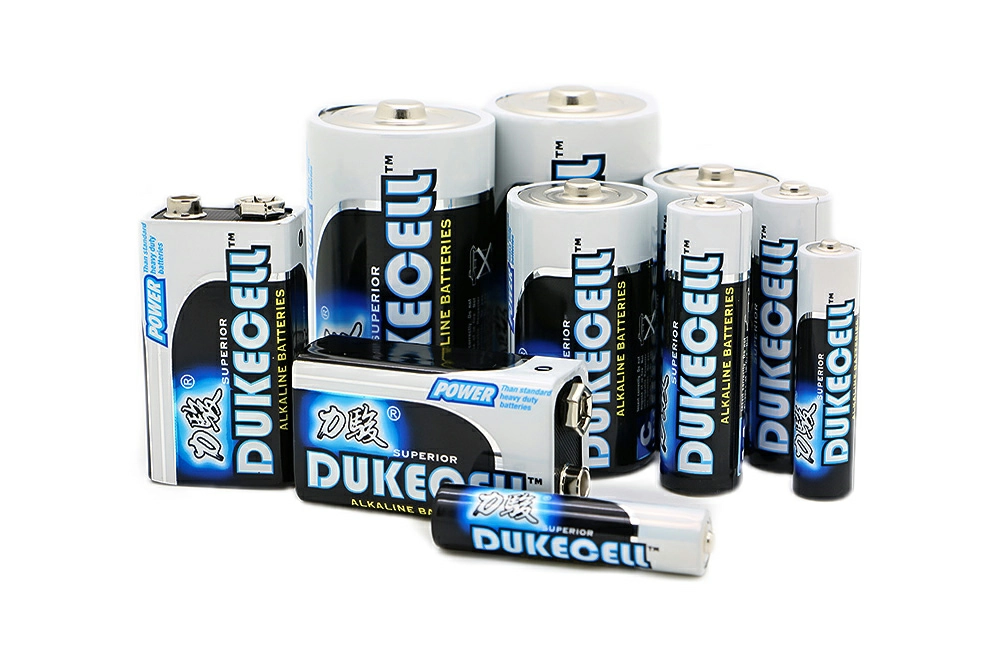
At Dukecell, we manufacture both alkaline and carbon-zinc batteries to the same rigorous quality standards. Our alkaline batteries (LR6, LR03, LR14, LR20) are designed for global markets with CE, RoHS, and SGS certification. Our carbon-zinc range (R6, R03, R14, R20) offers competitive pricing for cost-sensitive applications without compromising on safety.
Not sure which chemistry is right for your product? Contact our technical team [blocked] for a free consultation, or request samples [blocked] of both types to test in your application.